

ECMR as foundation for eFTI and NIS2

eFTI: the shift from “show the document” to “show the information” eFTI (electronic Freight Transport Information) is a European regulation that obliges all member states to accept digital documentation. This legislation provides a framework for supplying transport information digitally to competent authorities. Crucially, it is not about introducing one new document or a single new PDF standard, but about a shift: from a document culture to a data culture. Where inspections traditionally revolved around being able to hand over the consignment note and customs documents, the logic is shifting toward being able to demonstrate the underlying information—quickly, reliably, and verifiably. The benefits of this shift are significant. Less paper means fewer manual steps, fewer transcription errors, and less time lost during checks. In addition, eFTI lays the foundation for interoperability: in principle, systems across the supply chain can consult the same data, as long as that data is recorded consistently and can be made available in a standardized way. But that is also precisely why this is complex to operationalise. eFTI mainly harmonizes how data is shared, while which data is required in specific situations is, in many cases, defined nationally or sector-specifically. This is also why e‑CMR is extremely relevant: e‑CMR helps you to organize the issuing and handover of core information from shipper to carrier and b-t-b customer. That way, eFTI does not become “an extra compliance project,” but a logical next step for something you already need anyway. What does this mean in concrete terms? In 2026, for many organizations it is not enough to “have a digital document.” You must also be able to explain how the data was created, who the data owner/source of record is, and how changes are logged. e‑CMR—when implemented properly—brings that logic with it by default: registration, signing, timestamps, and a clear trail of events. NIS2: digital documentation also becomes a security and governance issue Parallel to EFTI, NIS2 is also imposing higher quality standards in data sharing. Supply chain parties have an obligation to organize data security across their supply chain. With NIS2, digitization shifts from “convenient and efficient” to “critical and controlled.” Transport and logistics are seen as a sector where digital disruptions can have major impact. As a result, cybersecurity, incident response, and supply chain risks move higher up the agenda. For digital transport documentation, this means you not only need to think about sharing information, but also about its reliability and security. Who has access to which data, how is misuse prevented, and how do you ensure that the data you present during an inspection is truly the current, correct data? In a world of integrations between shippers, carriers, and digital platforms, the need for end-to-end auditability is growing—along with the need to implement professional logging, access management, and audit trails. Here too, e‑CMR is a logical starting point: it forces you to properly organize rights, roles, access, and evidence around one critical flow (the digital consignment note), so you can later leverage this foundation for other data exchanges. Need a quick overview of laws and regulations in Europe? Download the Collect + Go whitepaper and receive the complete overview of laws and regulations. Download the whitepaper Fill out the form and you’ll get instant access to the whitepaper.
From European harmonization to day-to-day reality
eCMR: Solid foundation for e-FTI On paper it seems simple: Europe wants to digitize transport information, and eFTI provides a framework to share that information in a uniform way. In practice, however, 2026 is not an “end point” but a transition year. Many organizations are still in the midst of shifting from paper documents to end-to-end digitalization across the supply chain, while legislation and regulation continue to move forward. That creates friction, because regulations often speak in abstract terms (“the information must be available”), whereas day-to-day reality is about very concrete questions: can a driver present the right information immediately during an inspection, can supply chain partners consult the same version, and can your organization later demonstrate who recorded or changed what, and when? On top of that, inspections and enforcement largely determine what is considered “sufficient.” While some countries are already far along in digital acceptance, in others the reality remains hybrid, or interpretations differ by inspection authority. These differences are felt most strongly in cross-border transport and in domains with a higher risk profile—such as waste transport and dangerous goods. That is precisely where the pressure to tightly organize processes is greatest, because small administrative errors can have serious consequences: delays, fines, additional checks, or disputes with customers. That is why, in 2026, it makes sense not to approach digitization as “scanning documents,” but as building a robust information chain. e‑CMR is often the practical lever here: the digital consignment note forms the foundation for road transport documentation. This document is particularly well suited to move from “paper/PDF” to “data + audit trail.” Once that foundation is in place, other document flows (waste, ADR, national registrations) often become much easier to manage. Need a quick overview of laws and regulations in Europe? Download the Collect + Go whitepaper and receive the complete overview of laws and regulations. Download the whitepaper Fill out the form and you’ll get instant access to the whitepaper.
laws and regulations
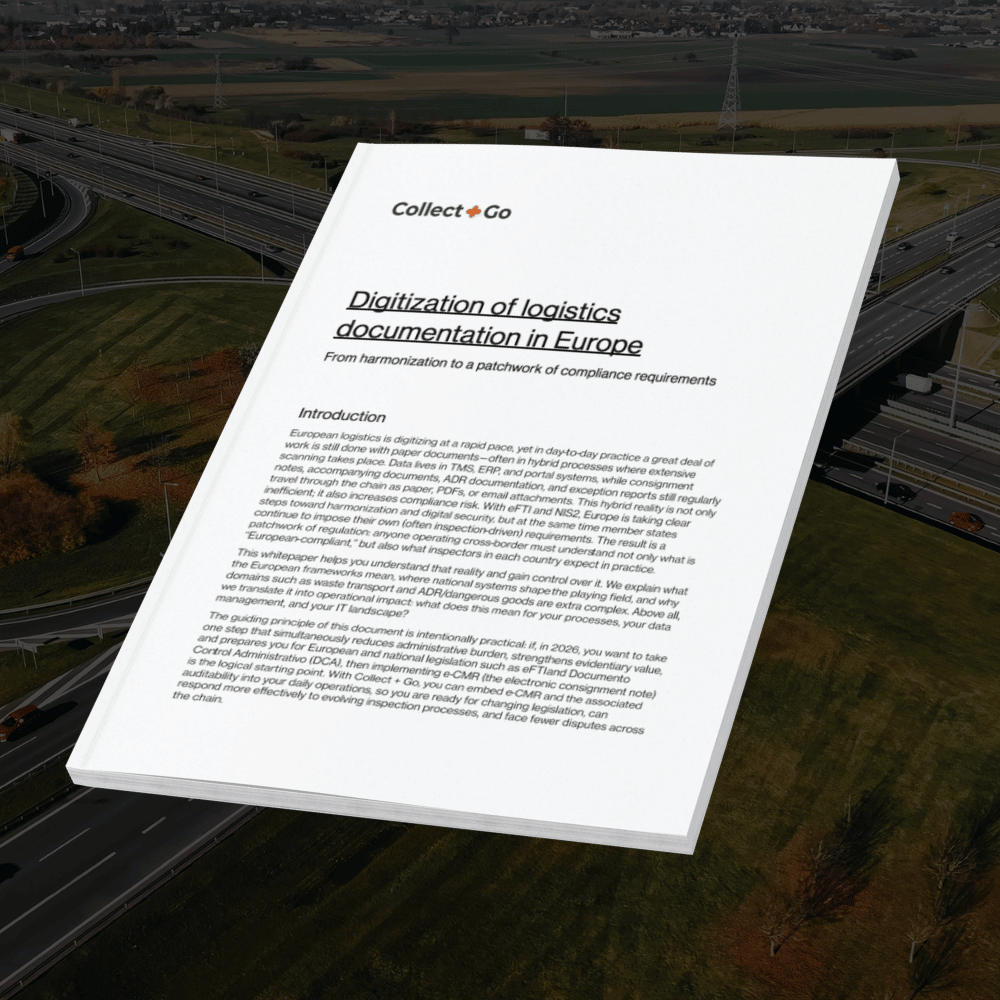
Logistics & transport laws and regulations in 2026: what’s changing (and what do you need to put in place already)? 2026 is a turning point for many logistics organizations. Digitization is no longer a “nice-to-have,” but increasingly a prerequisite to stay compliant, operate efficiently, and reduce risk. At the same time, the rules of the game are getting stricter: more supply-chain transparency, higher requirements for data exchange and (cyber)security, and more oversight of how well your processes and documentation are in order. The good news: if you digitize the foundation of your transport documentation and data flows in a smart way, using e‑CMR, for example: it becomes much easier to keep pace with new laws and regulations. With the Collect + Go e‑CMR solution, you record information correctly from the start, keep evidence and history in order, and can demonstrate compliance more quickly. Need a quick overview? Download the Collect + Go whitepaper to get the complete overview of laws and regulations. Download the whitepaper Fill out the form and you’ll get instant access to the whitepaper. DCA (Documento de Control Administrativo): administrative checks in road transport The Documento de Control Administrativo (DCA) is an administrative control document for the road transport of goods in Spain. Its digital version is referred to as the Documento electrónico de Control Administrativo (DeCA). It can be seen as the document that enables Spanish inspection authorities to verify the essential details of a transport operation, such as who is transporting the goods, what is being transported, the origin and destination of the shipment, and the date of transport. From 5 October 2026, the electronic DeCA will become mandatory for domestic road freight transport within Spain and cabotage operations carried out in Spain. For international road transport, the existing international transport documents, such as the CMR and e-CMR, will remain the applicable standard for the time being. With Collect + Go’s e-CMR solution, your transport information is available digitally, completely, and in a fully auditable format. This not only ensures that you are prepared for today’s international transport documentation requirements, but also for additional national obligations such as Spain’s DeCA. Here’s what to do to get started: make sure you clearly understand which documents and core data you need to have ready during inspections, where they currently live, and who manages the process. If you standardize and digitize this with e‑CMR, compliant operations become not only easier, but also much more efficient. In the Collect + Go whitepaper, you’ll find the complete overview and the practical translation to e‑CMR and compliance. Download the Whitepaper eFTI (Electronic Freight Transport Information): from paper to digital transport information The eFTI Regulation is driven by one clear shift: transport information must increasingly be available and exchangeable digitally, so that inspections, audits, and supply chain collaboration become faster, more reliable, and less error-prone. In practice, this translates into more requests for digital documents and data (instead of, or alongside, the paper version). Data exchange across the chain also becomes more important: shippers, carriers, logistics service providers, and inspection authorities need to be able to access and trust the same information more quickly. And perhaps most importantly: the impact doesn’t just affect IT, but also process agreements, responsibilities, and document management. If that foundation isn’t solid, digitization quickly becomes a source of extra work rather than less. Why this is already relevant now: eFTI is the kind of development you don’t want to react to only in 2027. If you wait until it’s mandatory, you risk having to find an ad hoc solution under time pressure. In the Collect + Go whitepaper, we explain how eFTI relates to digital consignment notes and why e‑CMR is a logical step to become eFTI-ready—without treating it as “extra administration.” Download the Whitepaper NIS2: cybersecurity is becoming a key priority NIS2 is, for many organizations, the point at which cybersecurity is no longer “just an IT issue.” The core message: organizations must actively manage risks, be able to report incidents, and have demonstrable measures in place. Even if your organization does not fall directly under NIS2, you may still be affected. Customers and partners may impose stricter requirements across the supply chain, vendor management and security agreements become more serious, and incidents (such as data breaches or disruptions) can more quickly have major reputational and operational impact. In practical terms, this means you’ll want clarity on which systems are truly critical to your operations, who has access to what data, and how quickly you can respond if something goes wrong. Here too, the same principle applies: the more you digitize and standardize your processes (for example around transport documentation and evidentiary value with e‑CMR), the more control you gain over who can access which data and how you can demonstrate the integrity of your information. In the Collect + Go whitepaper, you’ll find a clear overview of the key themes for 2026, including how e‑CMR helps you stay compliant. Download the Whitepaper Other relevant themes toward 2026 In addition to eFTI, DCA, and NIS2, we also see a number of recurring themes in the sector as 2026 approaches. Think further digitization & compliance (more data integrations and greater verifiability), stricter audits & supply chain agreements (who is responsible for what in the exchange of information?), more process standardization (fewer exceptions and less manual work), and above all data quality: a single source of truth prevents errors and noise across the chain. Want to know what this means in concrete terms for your situation? In the whitepaper, we bring the complete overview together and translate it into practical points of attention. Download the whitepaper Fill out the form and you’ll get instant access to the whitepaper.
Checklist DCA

The digital DCA obligation in Spain is getting closer, but its scope has now been clarified. From 5 October 2026, the Documento electrónico de Control Administrativo (DeCA) will become mandatory for domestic goods transport within Spain and cabotage transport within Spain. For international road transport, the existing international transport documents, such as the CMR and e-CMR, will remain leading for the time being. Digital data exchange with inspection authorities is expected to increasingly take place via the European eFTI framework in the future. This means that not every transport to, from or through Spain automatically requires a separate DeCA. However, it remains important that transport information is digitally, completely and verifiably available. This is especially relevant if you are active in Spain, carry out cabotage operations, or want to prepare your processes for further digitalisation. With the e-CMR solution from Collect + Go, you ensure that freight information is digitally, structurally and verifiably available. This allows you to work more efficiently within your current document flows and be better prepared for additional national obligations such as the Spanish DeCA. In this article, you will find a practical set of checkpoints to help assess whether your document and data process is logically structured. See this as an orientation and improvement check: it provides direction, but does not replace a legal assessment or tailored advice. Important: This checklist is intended as general information and helps with awareness and preparation. It is not legal advice and not confirmation that you fully comply with the DeCA obligation. The exact requirements and application may differ depending on the situation. Why a supply chain check is needed The DCA / DeCA is not a new transport contract, but a Spanish control document for inspections. The CMR consignment note mainly concerns agreements and evidence around transport. The DeCA mainly focuses on the verifiability of mandatory transport data. For international transport, the CMR or e-CMR remains the starting point for the time being. For domestic transport and cabotage within Spain, the electronic DeCA becomes relevant. In both cases, the same principle applies: if the data is not correct, there is still a risk of delays, discussion or additional administrative work. DCA or DeCA compliance is rarely the responsibility of one party alone. In practice, issues often arise during data handover, for example when: a loading address is incomplete, vehicle details are shared too late, a document does not contain the right data, or the driver cannot show the right information. By making agreements in advance and organising your data flow properly, you reduce the risk of delays, discussion and stress on the road. Quick DCA / DeCA supply chain check Do you want to assess the main risks in 5 minutes? Use this short check as a starting point. You can request our full checklist with additional checkpoints and explanations at the bottom of this article. Scope: which trips fall under DeCA? Map out which transports fall under domestic goods transport within Spain or cabotage transport within Spain. These are the trips for which the electronic DeCA will become mandatory from 5 October 2026. If you mainly carry out international transport to, from or through Spain, CMR and e-CMR will remain leading for the time being. Still, map out these flows as well, so it is clear which documentation is required and which data must be digitally available. Role division: who provides which data? Define per party who is responsible for: loading and unloading information, cargo details, trip information, vehicle and carrier details. Goal: no grey areas. If everyone “thinks” someone else is handling it, mistakes happen. Data completeness: are the right fields always filled in? Check whether the required data is supplied structurally and without errors. It is about the completeness and timeliness of the data, not just about “having a document”. For DeCA-obligated trips within Spain, the dataset must align with the Spanish inspection requirements. For international transport, a complete and correct CMR or e-CMR remains important as the basis for digital, verifiable transport information. Availability: can the driver show it immediately? Test whether the right transport information is immediately available during an inspection on a mobile phone, tablet or other digital device. Also consider situations with limited connectivity. For domestic transport and cabotage within Spain, this concerns the digital availability of DeCA information. For international transport, this concerns the digital availability of the correct CMR/e-CMR information. Receive the full checklist Would you like to receive our full DCA checklist (including a list of which data is mandatory)? Request our DCA whitepaper here: FAQ 1) Do I also need to do something with DCA / DeCA as a shipper? That depends on your role in the chain. Even if you outsource transport, you often provide essential data, such as loading and unloading information or cargo details. If that data is missing, the chain can still get stuck. For domestic transport and cabotage within Spain, this is especially important because of the DeCA obligation. For international transport, correct input for the CMR or e-CMR remains important. 2) Is this only relevant for transport within Spain? The mandatory electronic DeCA applies from 5 October 2026 to domestic goods transport within Spain and cabotage transport within Spain. According to the new clarification, international transport to, from or through Spain does not automatically fall under a separate DeCA obligation. CMR and e-CMR remain leading there for the time being. However, it is wise to have international transport data digitally and completely available, also with future eFTI developments in mind. 3) What is the best first step if I want to start tomorrow? First map out your Spain-related transport flows. Make a distinction between: domestic transport within Spain, cabotage transport within Spain, international transport to, from or through Spain. Then define who provides and checks which data. This helps prevent the most common mistakes in the chain. Feel free to contact Collect + Go to discuss what DCA / DeCA means for your organisation.
What is the Documento de Control Administrativo (DCA)?

The Documento de Control Administrativo (DCA) is an administrative control document for road freight transport in Spain. The digital version is also referred to as the Documento electrónico de Control Administrativo (DeCA). You can see it as the document Spanish inspection authorities use to check whether a transport operation is correct in terms of basic information, such as who is transporting the goods, what is being transported, from where to where, and when. From 5 October 2026, the electronic DeCA will become mandatory for domestic goods transport within Spain and cabotage transport within Spain. For international road transport, existing international transport documents, such as the CMR and e-CMR, will remain leading for the time being. With the e-CMR solution from Collect + Go, you ensure that freight information is digitally, completely and verifiably available. This means you are prepared not only for current international document flows, but also for additional national obligations such as the Spanish DeCA. Why does the DCA exist? The DCA has one main purpose: verifiability. The document helps Spanish authorities quickly verify whether a transport operation complies with the rules. It is therefore not “extra paperwork for the sake of paperwork”, but a way for Spain to maintain control over transport flows. It is important to know that the DCA is similar to the CMR consignment note in some areas, but it has a different function. The CMR is an international transport document. The DCA / DeCA is a Spanish control document for inspections. DCA versus (e-)CMR: what is the difference? The CMR is an international consignment note used as evidence and as a contractual document between parties in the chain. The DCA / DeCA, by contrast, is a Spanish control document: it is less about the contract and more about being able to show mandatory information during an inspection. For international transport, the CMR and e-CMR remain the correct starting point for the time being. According to the latest Spanish clarification, no separate DeCA needs to be prepared for international road transport to, from or through Spain. For domestic transport and cabotage within Spain, however, the electronic DeCA will become mandatory. In that case, it is important that the correct data is digitally available and can be shown during inspections. For whom is the DCA mandatory? From 5 October 2026, the mandatory electronic DeCA applies to: For international transport, existing international transport documents, such as the CMR and e-CMR, will remain applicable for the time being. Digital data exchange with inspection authorities is expected to increasingly take place via the European eFTI framework in the future. This means that international carriers will usually not need to prepare a separate DeCA for cross-border journeys in the short term. However, it remains important to keep transport data digitally, completely and verifiably available. What information must it contain? The DCA / DeCA contains the key details of the transport operation. Below is an overview of data that may be relevant during an inspection: Much of this information is often already available within an e-CMR process. Collect + Go can therefore help make transport data digitally, structurally and verifiably available. Digital DCA: what changes towards 2026? Spain has further clarified the introduction of the electronic DeCA. From 5 October 2026, the obligation will apply to domestic goods transport within Spain and cabotage transport within Spain. For international road transport, the CMR and e-CMR will remain leading for the time being. Spanish regulations refer to the future European eFTI framework for international transport information. Digital data exchange with inspection authorities is expected to increasingly take place via eFTI from 2027 onwards. For companies carrying out domestic transport or cabotage in Spain, this means they need to digitise their document flow in time. Drivers must be able to show the correct information digitally, chain partners must be sure that the data is complete, and the document flow must be inspection-proof. With the e-CMR solution from Collect + Go, you can secure this process in practice: freight documents are digitally available, datasets are more complete, and inspections can be handled faster and more consistently. Who is responsible in the chain? In practice, correct transport documentation is a shared responsibility. The shipper or client often provides data about origin, destination and cargo. The carrier often provides vehicle and trip details and must be able to show the correct information during the journey. For domestic transport and cabotage within Spain, it is therefore important to agree in advance who enters which data, who checks it, and what happens if information is missing or incorrect. For international transport, the same principle applies: even if the DeCA is not mandatory as a separate document, the CMR or e-CMR must still be complete and correct. What is the risk if you don’t have it in order? If an inspection shows that mandatory transport information is missing or incorrect, this can lead to fines, delays and additional administrative handling. Apart from enforcement, an incomplete document flow also creates friction between chain partners. No one wants to discover during a journey that mandatory data is missing. That is why it is wise to structure transport data digitally and systematically now. Conclusion The DCA / DeCA is a Spanish control document that will become mandatory in electronic form from 5 October 2026 for domestic goods transport and cabotage within Spain. For international transport to, from or through Spain, the CMR and e-CMR will remain leading for the time being. Future digital data exchange with inspection authorities will probably increasingly take place via the European eFTI framework. If you carry out domestic transport or cabotage in Spain, it is wise to prepare your document flow for the DeCA obligation in time. If you operate internationally, a complete and well-structured e-CMR remains important as the basis for digital, verifiable transport information. With the e-CMR solution from Collect + Go, you have freight documents digitally available and are better prepared for both current documentation requirements and future European developments. FAQ 1) Is
Spanish Sustainable Mobility Law: what does this mean for digital transport documents?

Spanish Sustainable Mobility Law: what does this mean for digital transport documents? The Spanish Ley de Movilidad Sostenible marks an important step in the further digitalisation of transport and logistics. The law sets out a broader framework to make mobility more sustainable, safer and more digital, and also affects the way transport documentation is organised and checked. An important element is the further clarification of the Documento electrónico de Control Administrativo (DeCA). This is the digital version of the Spanish administrative control document for goods transport. The recent Spanish clarification makes clear that the mandatory electronic DeCA will apply from 5 October 2026 to domestic goods transport within Spain and cabotage transport within Spain. For international road transport, the existing international transport documents, such as the CMR and e-CMR, will remain leading for the time being. This means that international transport to, from or through Spain does not automatically require a separate DeCA. Digital data exchange with inspection authorities is expected to increasingly take place via the European eFTI framework in the future. What this means for the market: 👉 DeCA will become mandatory from 5 October 2026 for domestic transport and cabotage within Spain 👉 For international transport, CMR and e-CMR will remain leading for the time being 👉 Digital transport data is becoming increasingly important for verifiability and future compliance 👉 eFTI is expected to become the future framework for international digital data exchange For the sector, this still sets a clear direction: digitalisation is shifting from an efficiency choice to a condition for verifiable and future-proof logistics. However, the scope has become more important. Not every international transport to or through Spain falls under a separate DeCA obligation, but organisations active in Spain would be wise to get their document flows and data management in order now. For companies carrying out domestic transport or cabotage in Spain, preparation for the electronic DeCA is directly relevant. For international carriers, a complete and correct CMR or e-CMR remains the foundation. In both cases, a digital solution helps make transport information more accessible, verifiable and future-proof. In short: this is not a hypothetical development, but part of a broader movement towards digital transport documentation in Europe. Successful players do not wait until enforcement or new European frameworks are fully finalised, but make sure their data, processes and document flows are already in order. Want to know more about e-CMR? Contact us!
