
Logistics & transport laws and regulations in 2026: what’s changing (and what do you need to put in place already)?
2026 is a turning point for many logistics organizations. Digitization is no longer a “nice-to-have,” but increasingly a prerequisite to stay compliant, operate efficiently, and reduce risk. At the same time, the rules of the game are getting stricter: more supply-chain transparency, higher requirements for data exchange and (cyber)security, and more oversight of how well your processes and documentation are in order.
The good news: if you digitize the foundation of your transport documentation and data flows in a smart way, using e‑CMR, for example: it becomes much easier to keep pace with new laws and regulations. With the Collect + Go e‑CMR solution, you record information correctly from the start, keep evidence and history in order, and can demonstrate compliance more quickly.
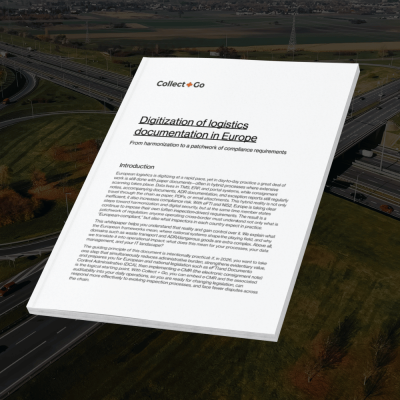
Need a quick overview? Download the Collect + Go whitepaper to get the complete overview of laws and regulations.
Download the whitepaper
Fill out the form and you’ll get instant access to the whitepaper.
DCA (Documento de Control Administrativo): administrative checks in road transport
The Documento de Control Administrativo (DCA) is an administrative control document for the road transport of goods in Spain. Its digital version is referred to as the Documento electrónico de Control Administrativo (DeCA).
It can be seen as the document that enables Spanish inspection authorities to verify the essential details of a transport operation, such as who is transporting the goods, what is being transported, the origin and destination of the shipment, and the date of transport.
From 5 October 2026, the electronic DeCA will become mandatory for domestic road freight transport within Spain and cabotage operations carried out in Spain. For international road transport, the existing international transport documents, such as the CMR and e-CMR, will remain the applicable standard for the time being.
With Collect + Go’s e-CMR solution, your transport information is available digitally, completely, and in a fully auditable format. This not only ensures that you are prepared for today’s international transport documentation requirements, but also for additional national obligations such as Spain’s DeCA.
Here’s what to do to get started: make sure you clearly understand which documents and core data you need to have ready during inspections, where they currently live, and who manages the process. If you standardize and digitize this with e‑CMR, compliant operations become not only easier, but also much more efficient.
In the Collect + Go whitepaper, you’ll find the complete overview and the practical translation to e‑CMR and compliance.
eFTI (Electronic Freight Transport Information): from paper to digital transport information
The eFTI Regulation is driven by one clear shift: transport information must increasingly be available and exchangeable digitally, so that inspections, audits, and supply chain collaboration become faster, more reliable, and less error-prone.
In practice, this translates into more requests for digital documents and data (instead of, or alongside, the paper version). Data exchange across the chain also becomes more important: shippers, carriers, logistics service providers, and inspection authorities need to be able to access and trust the same information more quickly. And perhaps most importantly: the impact doesn’t just affect IT, but also process agreements, responsibilities, and document management. If that foundation isn’t solid, digitization quickly becomes a source of extra work rather than less.
Why this is already relevant now: eFTI is the kind of development you don’t want to react to only in 2027. If you wait until it’s mandatory, you risk having to find an ad hoc solution under time pressure.
In the Collect + Go whitepaper, we explain how eFTI relates to digital consignment notes and why e‑CMR is a logical step to become eFTI-ready—without treating it as “extra administration.”
NIS2: cybersecurity is becoming a key priority
NIS2 is, for many organizations, the point at which cybersecurity is no longer “just an IT issue.” The core message: organizations must actively manage risks, be able to report incidents, and have demonstrable measures in place.
Even if your organization does not fall directly under NIS2, you may still be affected. Customers and partners may impose stricter requirements across the supply chain, vendor management and security agreements become more serious, and incidents (such as data breaches or disruptions) can more quickly have major reputational and operational impact. In practical terms, this means you’ll want clarity on which systems are truly critical to your operations, who has access to what data, and how quickly you can respond if something goes wrong.
Here too, the same principle applies: the more you digitize and standardize your processes (for example around transport documentation and evidentiary value with e‑CMR), the more control you gain over who can access which data and how you can demonstrate the integrity of your information.
In the Collect + Go whitepaper, you’ll find a clear overview of the key themes for 2026, including how e‑CMR helps you stay compliant.
Other relevant themes toward 2026
In addition to eFTI, DCA, and NIS2, we also see a number of recurring themes in the sector as 2026 approaches. Think further digitization & compliance (more data integrations and greater verifiability), stricter audits & supply chain agreements (who is responsible for what in the exchange of information?), more process standardization (fewer exceptions and less manual work), and above all data quality: a single source of truth prevents errors and noise across the chain.
Want to know what this means in concrete terms for your situation? In the whitepaper, we bring the complete overview together and translate it into practical points of attention.
Download the whitepaper
Fill out the form and you’ll get instant access to the whitepaper.